
Biomedical Reader Tool: AI-Powered Scientific Paper Analyzer
Published:
Project Overview
The Biomedical Reader Tool is a cutting-edge AI-powered application designed to assist physicians, researchers, and medical professionals in rapidly analyzing and comprehending biomedical scientific papers. Leveraging state-of-the-art natural language processing (NLP) and machine learning techniques, the tool offers a suite of advanced features to enhance the user’s ability to extract valuable insights, understand complex relationships, and make informed decisions based on academic research, look at medicalred.com.
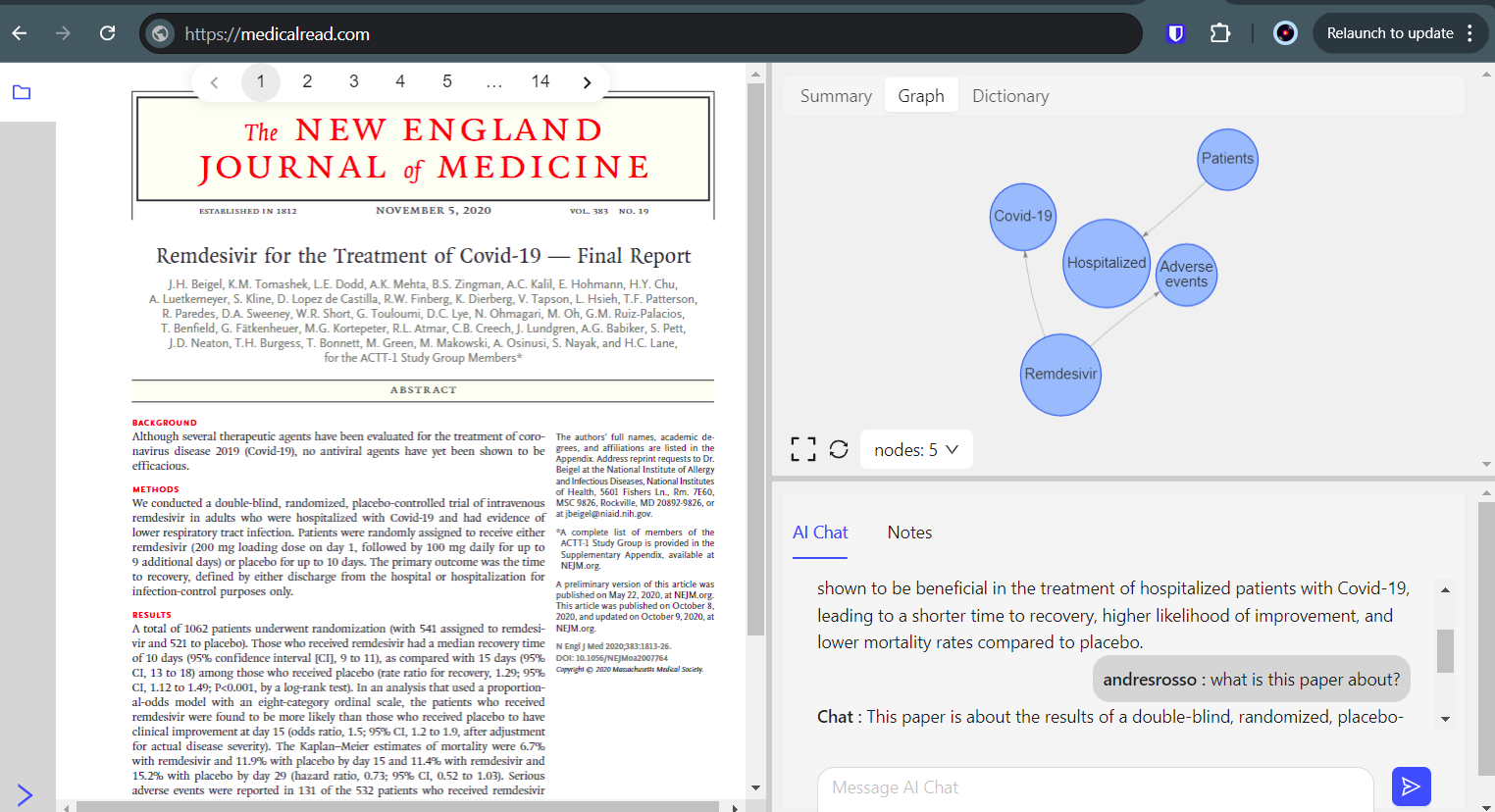
Key Features
1. Graph-Based Relationship Extraction
- Automatically identifies and visualizes relationships between critical entities such as diseases, treatments, patient populations, and outcomes.
- Provides an interactive graph representation that allows users to explore key connections within the paper.
- Enables filtering of entities based on relevance or type (e.g., diseases, drugs, genes).
2. Intelligent Question Answering
- Allows users to ask detailed, paper-specific questions in natural language.
- Returns precise answers, supported by evidence from the text.
- Includes multi-turn conversations, enabling users to refine queries or dive deeper into specific topics.
3. Concept Definitions
- Automatically extracts and defines key biomedical terms and concepts from the paper.
- Provides concise, context-aware explanations for complex terms.
- Includes integration with external biomedical databases (e.g., PubMed, MeSH) for comprehensive definitions.
4. Advanced Summarization
- Generates summaries tailored to the user’s needs (e.g., clinical focus, research highlights).
- Includes abstracts, highlights of key findings, and insights into the paper’s methodologies and implications.
- Supports customizable summary lengths and formats.
5. Cross-Paper Analysis
- Compares key findings and relationships across multiple uploaded papers.
- Highlights contradictions, consistencies, or complementary data points between studies.
- Generates aggregated graphs showing the combined relationships between entities across sources.
6. Interactive User Interface
- User-friendly interface designed for medical professionals with intuitive navigation and tools.
- Includes tabs for summary, graph, dictionary, Q&A, and full-text viewing.
- Allows seamless switching between detailed analysis and high-level summaries.
7. Customizable Settings
- Supports domain-specific configurations for different fields (e.g., oncology, cardiology, genomics).
- Users can define their own priorities, such as focusing on specific entities or methodologies.
- Offers dark mode and accessibility settings for enhanced user experience.
8. Collaboration and Sharing
- Enables saving and exporting graph visualizations and summaries for presentations or collaborative discussions.
- Supports annotations and highlights that can be shared with colleagues.
- Integrates with platforms like Google Drive, Dropbox, and email for easy file sharing.
9. Real-Time Updates and Alerts
- Sends notifications when new relevant papers are published in the user’s field of interest.
- Suggests related research papers based on the content analyzed.
Applications
The Biomedical Reader Tool has transformative applications in:
- Clinical Practice: Assisting physicians in staying updated with the latest treatments and research.
- Academic Research: Supporting researchers in hypothesis generation and literature reviews.
- Pharmaceutical Development: Streamlining drug discovery by analyzing clinical trial data and outcomes.
- Education: Aiding medical students and trainees in comprehending complex scientific literature.
Technology Stack
- Core NLP Frameworks: SpaCy, Hugging Face Transformers, BioBERT, and SciBERT.
- Graph Frameworks: NetworkX, Neo4j, and GraphQL for relationship modeling and visualization.
- Frontend: Built with React.js for an interactive and responsive user experience.
- Backend: Python (FastAPI) and Google Cloud for scalable processing.
- Deployment: Hosted on Google Cloud Platform (GCP) with high-availability and fault-tolerant architecture.
Access the Tool
Explore the Biomedical Reader Tool live at: Assistant Medical Tool
This tool exemplifies the intersection of advanced AI and healthcare, empowering professionals to maximize their understanding and application of biomedical research. Let me know if you need further details or have suggestions for enhancing the tool!